Simple, Radical, Spiritual...
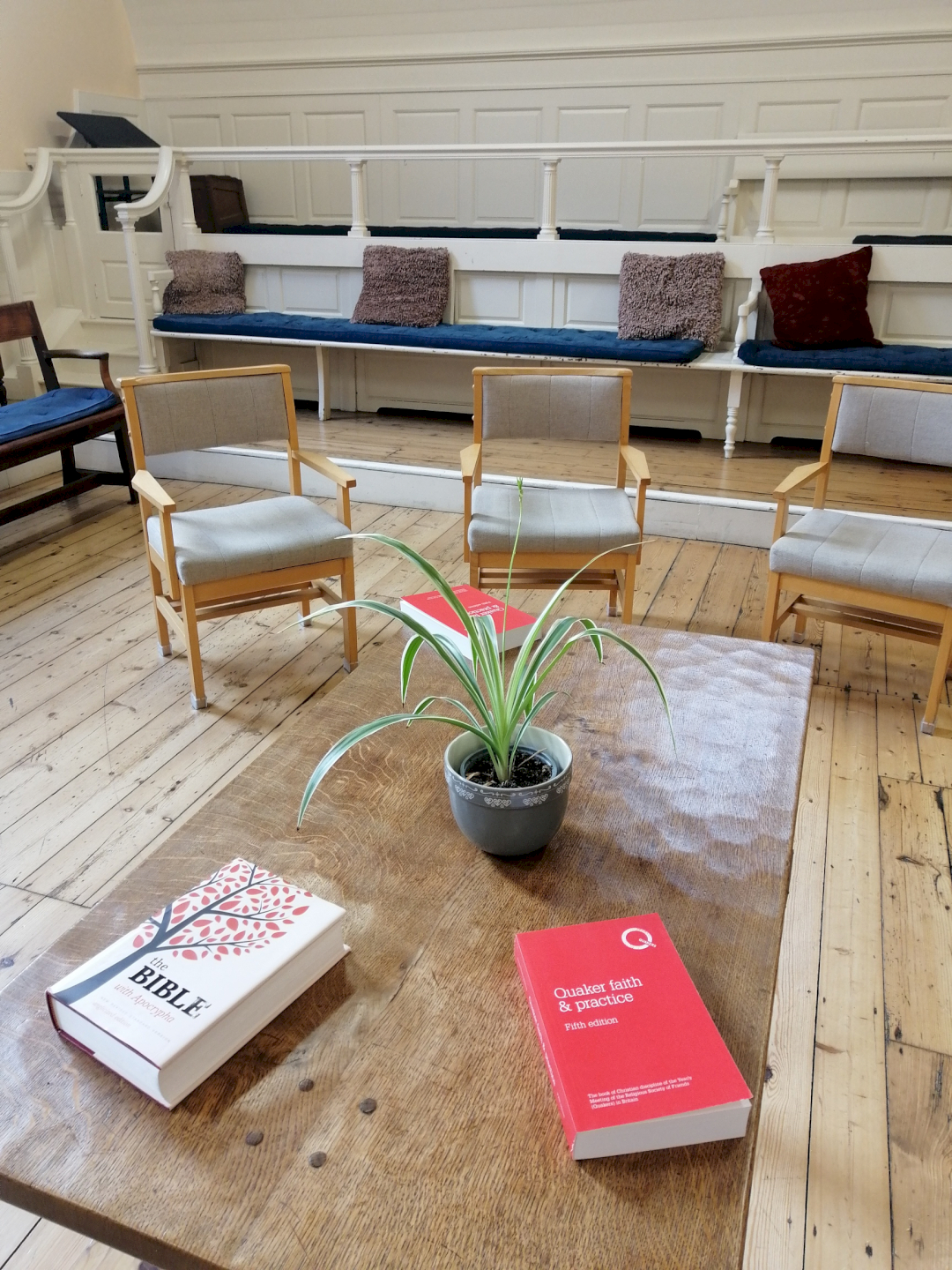
In Meeting for Worship, we aim to quieten both body and mind so we can access a deeper place within ourselves where we may find the Light.
Some of the tools we may use might sound familiar to those who meditate, but it is important to point out that a silent Quaker Meeting for Worship is not a meditation. It is is very much a communal activity where the Light within each individual can uphold, and be upheld by, others.
If you consider a candle, one candle on its own sheds a little light, but when we come together the light is far brighter. We seek to find the tranquil centre within and so the stillness of each person meets the stillness of others. That of God within each of us is encountering the Divine.
What happens during Meeting for Worship?
We do not have a priest and we have no set prayers, hymns or sermons. Our meetings are based on a silence of waiting and listening. There may be silence for quite some time, perhaps even for the whole meeting. But that does not mean nothing is happening. We try to hold ourselves aware of all those gathered with us, uniting in a common purpose, so that the waiting and listening become an act of sharing but without reciting creeds, singing hymns or repeating set prayers.
The silence may be broken if someone present feels called to say something which will deepen and enrich the worship. Anyone is free to speak, pray or read aloud, as long as it is done in response to a prompting of the spirit which comes in the course of the meeting. This breaks the silence for the moment, but does not interrupt it.
Listen with an open mind to what is said. Each contribution may help somebody, but our needs are different and can be met in different ways. If something does not speak to your condition or need, try to reach the spirit behind the words. The speaker wants to help the meeting, so take care not to reject the offering by negative criticism.
Each of us brings our own life experience to meeting. Some people will have a profound sense of awe and wonder because they know God is present. Others will be far less certain. If the word God has difficult associations for you, using a different image or concept such as ‘spirit’ or ‘light’ can be helpful.
In the quietness of a Quaker meeting worshippers can become aware of a deep and powerful spirit of love and truth, transcending their ordinary experience. We seek to become united in love and strengthened in truth, so we enter a new level of living, despite the different ways we may account for this life-expanding experience.
A bit of Quaker history
Many in society during the later 17th century were disillusioned with the power and complacency of the established church. It seemed out of touch and too hierarchical. George Fox, one of the founders of Quakers had a vision of a simpler more direct faith, one that had no need of priests to interpret.
A few key facts about Quakers
- Quakerism is rooted in Christianity but today, Quakers are a broad based group who believe that there is something of God (or the divine) in everyone. We seek to 'meet' this in all people and see all humans as equal and deserving of equal treatment and respect.
- Everyone can access the inner light (God, Spirit, Other..) directly without need of priests, bible or other holy books. We just our own experiences if they are driven by this inner light to be valid. It perhaps explains why we dont share a set of strict beliefs governing our church.
- The Quaker experience is that it effects our whole lives. It leads us, individually and together, to work towards a more just and peaceful world, and a more sustainable lifestyle.
- Quakers see no need for churches, rituals, holy days, or sacraments, to experience the inner light. Rather faith should be something one lives and acts out every day.
- Quakers tend not to be strongly connected to a calendar of feast days. Early Friends didn't celebrate Christmas; most contemporary Quakers see it as part of the year cycle and some may individually feel attached to the Christian message it offers.
- Meeting for Worship is a central part of our practice. Our meetings are based on silent waiting and listening, and the silence can be very moving. Out of this silence someone may feel inspired to speak or read a short passage. These words are brief and may be helpful to others present.
- At Darlington Quaker Meeting you will find a diverse and welcoming community. Our official name is the Religious Society of Friends but we are today more commonly known as Quakers or Friends.
Discover more
Quakers then
George Fox had a vision on top of Pendle Hill in 1650 of a new faith gathering. Many joined him and as non conformists in a society where the established church had ultimate power, these new "Friends of the Truth" were quickly seen as a threat to authority.
Quakers were persecuted for most of the next 40 years, imprisoned, tortured and even killed for practising their faith.
From earliest times Quakers have followed their conscience on peace, truth, justice and simplicity. Their business sense and integrity led to growth of major firms still known today (though most are not still in Quaker management)
- Chocolate Quakers :Frys, Cadbury, Rowntrees
- Banking Quakers: Barclays, Backhouse, Gurney, Lloyds
- Other firms: Clarks shoes, Huntley & Palmer biscuits etc
William Penn founded Pennsylvania and Quakers are now to be found worldwide.
Quakers now - out in the world
Quakers have always felt their faith driving them to act in the world.
The Core Testimony of Peace, Truth, Simplicity & Sustainability underpins how we respond to issues of society and aim to improve the life of people and planet.
You'll find Quakers at the heart of many national and international causes, out on peace or climate Marches, working locally in Food banks or homeless shelters.
Coming to Quaker worship
A few practical tips (what, where when, how) if you decide to come along to worship with us for first time.
- Anything new and different is daunting!
- Come with an open mind
- No need to book. Just turn up.
- Red front doors on Skinnergate open at 10 am. Worship starts at 10.30 but aim for a bit before....
- How Quakers Worship